Pruning & trimming · Summerville
Most trees don’t need to go. They need to be edited.
Deadwood out, weight reduced, clearance restored — cuts made where the tree can close them, so the canopy that makes this town worth living in keeps standing through the storms that test it.
What we prune for
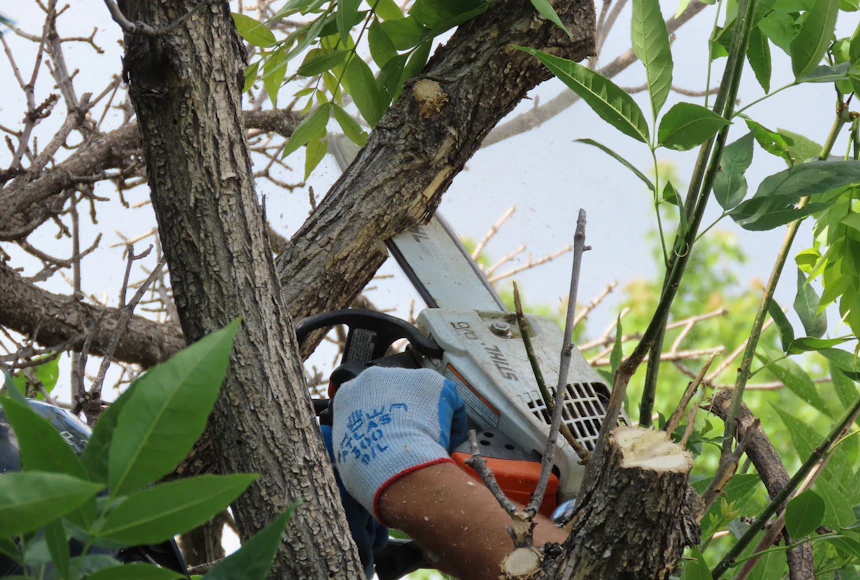
Every pruning job here is one of four errands. Deadwood: the brittle gray limbs that hurricane season turns into projectiles — out of the crown before the wind does it over your patio. Weight and length: the long horizontal laurel-oak limbs that grew toward the light and now levering over your roof; shortened back to good laterals, the strain drops enormously. Clearance: six to eight feet over the shingles, daylight between limbs and the service drop, sight lines at the driveway restored. Structure: young trees — especially the maples and elms going into new yards around Nexton — steered early so they build one strong trunk instead of a future split.
Why we will not top your tree
Topping — shearing the crown flat to make a tree “safer” or shorter — does the opposite of both. The stubs can’t close, so rot walks straight down into the trunk. The regrowth comes back fast, dense, and weakly attached, which hands the next tropical storm a crown full of pre-broken limbs. And a topped live oak in a town that put a pine on its official seal is a neighborhood-visible mistake for the next twenty years. If shorter is truly the goal, crown reduction to interior laterals gets height off while leaving a tree that still works like one. That’s the cut we make; topping we decline, politely, every time.
Timing, species by species
- Live oaks and laurel oaks — late winter is ideal, and sound pruning every few years is most of what keeps them hurricane-proof. Their wood is famously strong; their failure point is almost always an unpruned, overextended limb.
- Loblolly pines — pines are removal-or-leave-alone trees for the most part, but lower-limb cleanups and deadwood passes are routine. Browning needles are a different conversation, and one to have quickly.
- Crape myrtles — the annual chainsaw-flat “crape murder” you see around town is topping with better marketing. A properly thinned crape blooms just as hard and doesn’t grow the knuckles.
- Sweetgums and water oaks — the yard trees most likely to be quietly failing. A pruning visit doubles as an inspection, and we say so if what we’re seeing is a removal deferred.
What it costs, what stays legal
Pruning prices by time and rigging like everything else: a single-tree deadwood pass usually runs a few hundred dollars, a full structural prune on a big mature oak somewhat more, and multi-tree visits price better per tree because the setup is already paid for. You get it in writing before we start, same as a removal.
One legal note that surprises people: Summerville’s tree ordinance is about removal — ordinary maintenance pruning doesn’t need a permit. But pruning a protected tree to death is treated like removing it, which is one more reason the collar cuts and the restraint matter. The permit guide covers where the lines sit.
Book the edit, keep the tree.
Walk the yard with us and point at what worries you. We’ll tell you what should come off — and what should be left alone.